
International Human Rights Day 2025 | Connections to ALC’s Mission and Ethos
December 10, 2025
International Human Rights Day is observed every year on December 10—the day on which the United Nations General Assembly adopted, in 1948, the Universal Declaration of Human Rights. This Declaration empowers us all. The principles enshrined in it are as relevant today as they were in 1948.
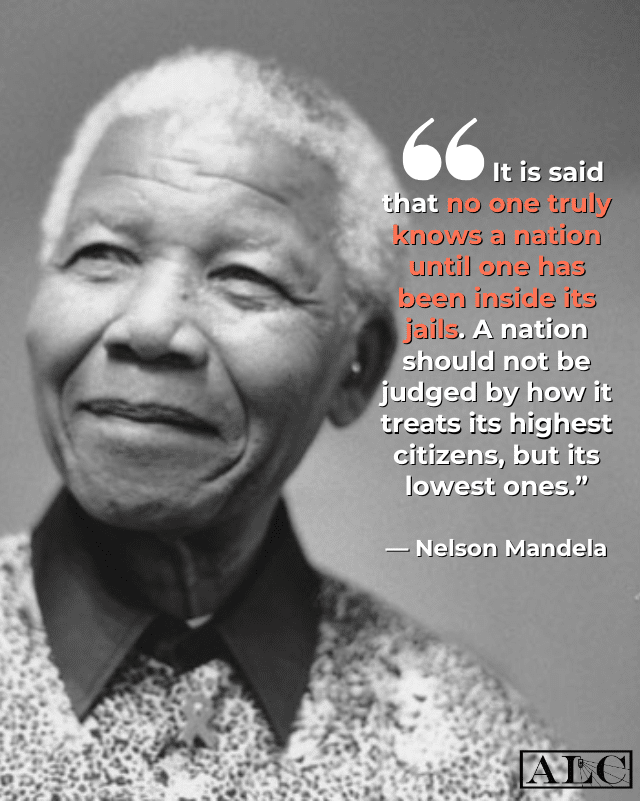 Since its inception, ALC has been dedicated to protecting human rights and employing an international framework in our legal strategies and organizing efforts. We have taken as a bedrock principle the words of former South African President and political prisoner, Nelson Mandela: “It is said that no one truly knows a nation until one has been inside its jails. A nation should not be judged by how it treats its highest citizens, but its lowest ones.”
As an arbiter of human rights around the world, in December 2015, the UN General Assembly unanimously adopted the “Nelson Mandela Rules“: 122 standard minimum rules for the treatment of prisoners, named to honor his legacy. The Mandela Rules represent the universally acknowledged blueprint for prison management in the 21st century. They outline minimum prison conditions, provide guidance, and set clear benchmarks for prison staff on how to uphold safety, security and human dignity. The Rules also offer an essential framework for challenging state violence in the criminal legal system. At minimum, incarcerated people should be protected by internationally recognized and accepted standards. ALC employs these standards in its legal strategies to protect the human rights of all incarcerated people.
For example, Mandela Rule 43 holds that the following practices should be prohibited:
(a) Indefinite solitary confinement;
(b) Prolonged solitary confinement;
(c) Placement of a prisoner in a dark or constantly lit cell;
(d) Corporal punishment or the reduction of a prisoner’s diet or drinking water;
(e) Collective punishment.
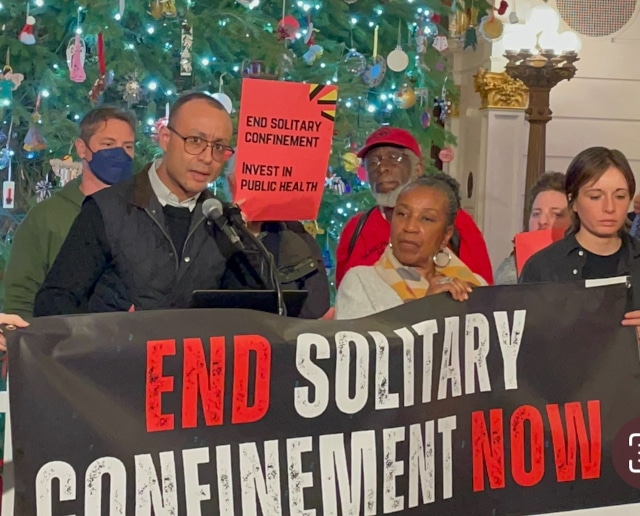 Rule 44 defines solitary confinement as the confinement of prisoners for 22 hours or more a day without meaningful human contact. “Prolonged solitary confinement shall refer to solitary confinement for a time period in excess of 15 consecutive days. Rule 45 holds:
1. Solitary confinement shall be used only in exceptional cases as a last resort, for as short a time as possible and subject to independent review, and only pursuant to the authorization by a competent authority. It shall not be imposed by virtue of a prisoner’s sentence.
2. The imposition of solitary confinement should be prohibited in the case of prisoners with mental or physical disabilities when their conditions would be exacerbated by such measures. The prohibition of the use of solitary confinement and similar measures in cases involving women and children, as referred to in other United Nations standards and norms in crime prevention and criminal justice, continues to apply.
But just as the U.S. regularly defies these rules, and did so for decades prior to their creation, the Trump administration’s ICE arrests and raids now brazenly defy the internationally accepted Mandela Rules for detainment. Rule 111 requires unconvicted prisoners to be presumed innocent and treated as such. Rule 119 states:
“Every untried prisoner has the right to be promptly informed about the reasons for his or her detention and about any charges against him or her. If an untried prisoner does not have a legal adviser of his or her own choice, he or she shall be entitled to have a legal adviser assigned to him or her by a judicial or other authority in all cases where the interests of justice so require and without payment by the untried prisoner if he or she does not have sufficient means to pay. Denial of access to a legal adviser shall be subject to independent review without delay.”
The rounding up of migrants and citizens, the deaths in detention centers which amount to concentration camps, the disappearing of neighbors and friends, many whom remain unaccounted for, the separation of children and families all harken back to the era of U.S. apartheid. While the international standards are the bare minimum, we must be vigilant and committed to fighting back.
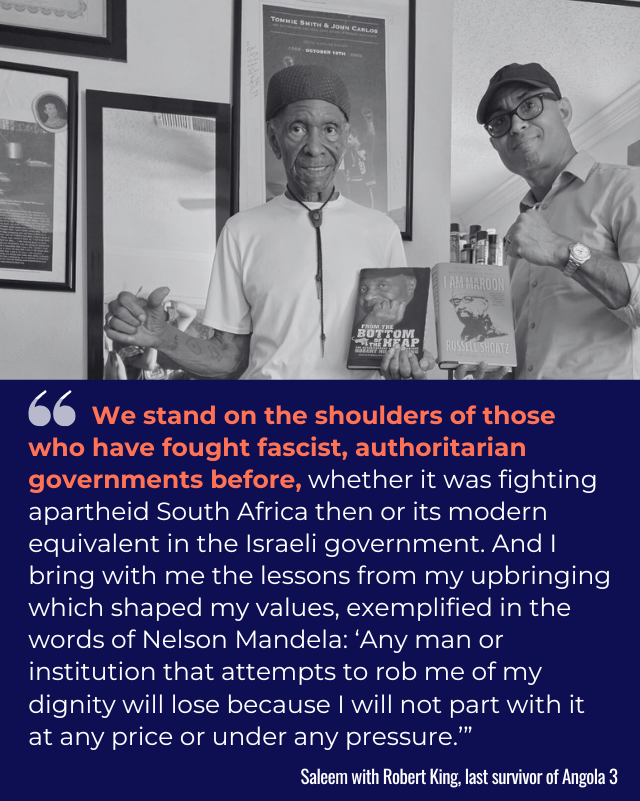 As our executive director, Saleem Holbrook, wrote in a recent op-ed, “Partnering with global advocates and allies to stand with us is critical to beating back the forces attempting to return us to a new version of American Apartheid….We will speak up at the highest stages and forums for the marginalized, and suffer whatever repercussions will be because we know that just like the South African Apartheid regime, Trump’s American version is not sustainable.”
Challenging state violence at home requires a commitment to looking beyond borders to understand and leverage innovative strategies and an abolitionist framework dedicated to building the strength of popular movements. Ultimately our movement must seek ways to redistribute power in support of human needs instead of state violence and corporate profit, and linking the local to the global in concept and practice.
Towards that end, in 2024, we launched ALC’s Human Rights Program, which has been employing legal tactics to directly challenge U.S. involvement and support in genocide.
We will continue to lean into the foundations of ALC—our human rights framework and internationalist view in our core campaigns: Solitary Confinement, Death by Incarceration, Jails, Policing, Release from Prison, Health & Environmental Conditions, Probation/Parole/Pre-Trial Detention, Political Rights, and Defending Democracy to challenge state violence and human rights violations in local jails, state prisons, and beyond.